Tuesday, 22 March 2016

Some styles of Bluetooth earpieces

Bluetooth technology has been designed for many different purposes and situations. Consequently, when people want to buy a bluetooth ear piece for a specific situation, there are some things that they will need to consider. Specifically, based on their specific situation and circumstances, they will need to review the best style of bluetooth earpiece that is available on the market today. Since there are different styles that have been made for for one or more reasons, it's important for each individual to do their research to see which style can accommodate their needs. It is also important to note that the kind the person purchases must be comfortable so that they can wear them for an extended period of time and they fit the devices that they will be used for. Listed below are three of the bluetooth styles that’s currently offered by manufactures all over the United States and abroad.

Bluetooth ear pieces for Mobile Phones

Most people take their mobile phones wherever they go. To work, school, church, parties and all kinds of other events that they may attend. Because these phones have become commonplace in many environments, people have a need to handle them and talk to others when their hands are free. This is also a great reason for individuals who work in certain settings to make sure that they are buying the right style that will best fit their needs.

One specific style that some people may choose is the ear cradle style of headphone. In fact, this kind of bluetooth earpiece is idea for people who want to spend their time working out and performing all kinds of other extracurricular activities. People are also encouraged to buy this kind of style because they may be driving when they receive a telephone call from a family member. Or, they may be working at the job typing a memo or walking around taking care of wide hosts of other kinds of activities that are not conducive to holding a mobile phone by hand to the ear. Whatever the situation, this style of bluetooth earpiece technology is great for many different situations and purposes.

Bluetooth ear pieces and Headsets for Music Lovers

In addition to the cradle style for mobile phones, people should also review other styles as well. One specific style that is also functional in many different settings is the DJ over the head headphones. This style has been designed for the serious music lovers, especially those who can appreciate making distinctions in sounds and beats that come from specific musical instruments like the bass, violin, trumpet and other popular instruments. For those who like and prefer this kind, they will also find that this is one of the best styles for keeping out outside noises that normally interfere with a person’s overall entertainment experience. Also, because they are wireless, they are great for people who like to stay mobile during the day instead of remaining in a sedentary position.

Bluetooth Ear Pieces for IPODs


In some situations, people may want to use bluetooth technology with their IPODs. Therefore, they should consider buying an additional popular style bluetooth earpiece technology. This style is known to be very popular, specifically because it is similar to an actual earbud. An ear bud is also another excellent choice for people who want to remain both active and hassle free. Though this is a great choice for people who like to remain mobile in a wide variety of different situations, one of its main draw backs is that they tend to fall out of the individuals ear. Which means, they can also be lost since it lacks additional support to keep them stabilized inside the ear.

Tuesday, 1 March 2016

ETRI presents a blueprint of the 5G Future

We will see a huge change in the way we access the the internet in the future when 5G is here, at speeds that only big businesses and high level internet companies see at the moment, we will have this to hand on our smart phones and tablets. When 5G is hundreds of times faster than any of the UK's broadbands, households will be looking to the mobile phone companies to supply their home broadband.

A 5G future is no longer a distant one, but an upcoming reality. High quality videos of more than 10Mbps can be served simultaneously to 100 users even in a train running at up to 500km/h. People can experience data rates that are 100 times faster than currently available technologies.

The Electronics and Telecommunications Research Institute (ETRI) of Korea will hold a "5G technology demonstration" on the 18th December, 2015. It will demonstrate future SNS (social network service) and several 5G core technologies such as "millimeter wave", "Mobile Hot-spot Network", "in-band full duplex" and so on.

5G is the next generation wireless technology that would provide even faster data rates, even lower delays, and even more devices connected than 4G. Accordingly, distinct and differentiated applications are expected in 5G.

ETRI's "future SNS" is a kind of trial service model to apply 5G technologies that provides dynamic user-centric connection to neighboring people, things and spaces. It is characterized by instant content-sharing between users, communication with neighboring things, and Giga-bps(Gbps)-grade video applications in vehicles.

5G core technologies demonstrated by ETRI include the following:

-- MHN (Mobile Hot-spot Network) is a mobile backhaul technology that provides high-speed Internet access of Gbps in vehicles at speeds of up to 500 km/h (e.g. KTX in Korea). Almost 100 passengers can watch videos of high quality simultaneously.

-- ZING is a near-field communication technology that enables mass data to be transmitted with 3.5 Gbps data rate between neighboring devices within the radius of 10cm.

-- Single-RF-Chain compact MIMO technology enables a single antenna to simulate the effect of multiple antenna. It can reduce antenna volume and cancel inter-antenna interference in a multi-antenna system.

-- Millimeter wave (mmWave) beam switching technology provides fast switching of radio beams to mobile users, and therefore allows seamless Gbps-grade service in mobile environments.

-- Mobile Edge Platform (MEP) is a mobile edge cloud server on vehicles that enables passengers to enjoy customized Gbps-grade content and connects them with neighbors, things and spaces. It provides user-centric services.

-- In-band Full Duplex technology can transmit and receive signals simultaneously over the same frequency band. It can increase spectral efficiency by up to two times.

-- Small cell SW technology is designed for AP(Access Point)-sized small cell base stations that can reduce communication dead zones and improve data rates per user in a hot-spot area.

"With this demonstration event, we are officially introducing our R&D results on 5G. We will continue to lead the development of 5G technologies. Also, we are trying to develop commercialization technologies needed by businesses, and to construct a 5G ecosystem." said Dr. Hyun Kyu Chung, vice president of ETRI Communication & Internet Lab.

In January, 2016, ETRI will demonstrate Giga internet service and future SNS in a Seoul subway train installed with MHN and ZING kiosks. ETRI will also introduce hand-over technology on a millimeter wave mobile communication system and 5G radio access technology that satisfies 1 millisecond radio latency.

About ETRI


Established in 1976, ETRI is a non-profit Korean government-funded research organization that has been at the forefront of technological excellence for about 40 years. In the 1980s, ETRI developed TDX (Time Division Exchange) and 4M DRAM. In the 1990s, ETRI commercialized CDMA (Code Division Multiple Access) for the first time in the world. In the 2000s, ETRI developed Terrestrial DMB, WiBro, and LTE-A, which became the foundation of mobile communications.

Recently, as a global ICT leader, ETRI has been advancing communication and convergence by developing Ship Area Network technology, Genie Talk (world class portable automatic interpretation; Korean-English/Japanese/Chinese), and automated valet parking technology. As of 2015, ETRI has about 2,000 employees where about 1,800 of them are researchers.

Thursday, 7 January 2016

Did Hitler Escape Death And Escape To Argentina Under Berlin

We all know how Adolf Hitler died, don’t we? It was April 30th, 1945. The Nazi cause had been well and truly lost and both the allied forces and the Red Army were invading Germany. Cowering in his bunker, the German dictator put a pistol to his head and fired. His new bride, Eva Braun, took a cyanide tablet and ended her own life shortly thereafter. Their bodies were then placed in a bomb crater, doused with petroleum and burned.

The official story effectively ends there. By the time Russian troops arrived at the scene, all that remained of one of history’s greatest mass-murderers was a charred lower jaw and dental bridge, which matched Hitler’s dental records and so proved that he had indeed died, with Braun, in the bunker.

However, declassified FBI documents reveal that the organisation was actively investigating a number of Hitler sightings during the post-war period. In fact, it appears that quite a few of the powers that be were treating Hitler’s apparent demise with understandably high levels of suspicion. These ideas gain a level of credence from the fact that the US Army was so convinced of Hitler’s survival that they actually mounted at least one covert operation to search for him.

Conspiracy theories abound that he may have faked his own death and escaped to South America, as a number of other high-ranking Nazi party members also managed to do.

Such theories are nothing new. Hitler’s post-war life has been postulated as taking place in locations as exotic and far afield as Brazil, Argentina and even the South Pole. In one instance, a clearly posed-for photo of a man purported to be Hitler made the news, although the facts that a) the man’s face cannot be properly seen, b) he is posing for a photograph in a relaxed and comfortable manner, something a wanted man would be extremely unlikely to do and c) he has a black girlfriend on his arm would suggest that this claim is utter nonsense.

Up until now, any theories of Hitler’s continued survival have had to rely upon elaborate, (often downright fanciful) descriptions of Hitler’s passage from Germany to wherever the authors assert that he ultimately ended up. Historians have exhaustively scoured travel manifests for clues (as if the most wanted man in the world would actually be listed as a passenger under his own name) and questioned scores of people who apparently knew, sighted or spoke to, an elderly Adolf Hitler.

In any instance, Hitler certainly had the means, as well as the motive, to fake his own death and flee Europe. Now, new evidence suggests that, whether he actually managed it or not, escape was almost certainly an option for him.

A hidden network of secret tunnels, located under the streets of Berlin, could hypothetically have enabled Hitler to escape. According to a new documentary series commissioned by the History channel, a false wall, located in a Berlin subway station, could easily have provided an escape route for the dictator.

The team assembled for this task is of a high pedigree, among their number are ex-CIA operative Bob Baer, upon whom George Clooney’s character in the film Syriana is based. He is perhaps best known as one of the men who helped track down Saddam Hussein. Joining Baer is Tim Kennedy, a US special forces operative who was tasked with tracking Osama Bin Laden after 9/11 and Sascha Keil, a German historian representing the Berlin Underworlds association. The team treated Hitler’s proposed escape as a cold case in the modern sense and began a lengthy and thorough investigation into the possibility and plausibility of Hitler’s flight from Germany.



According to the team’s research, a great many Nazis fled Germany from Tempelhof Airport on the 21st April, just one day after Hitler’s final public appearance. Among this exodus were eight planes apparently loaded with Hitler’s personal possessions. Calculating an underground route from Hitler’s last known location to Tempelhof, the team reasoned that he could have made the journey almost entirely underground, except for the last 200 yards or so. The discovery of the false wall/new tunnel, confirmed by sonar analysis, would have connected the subway station (then known as U6) with the airport, allowing Hitler and his entourage to slip away unnoticed as the Soviets marched on the capital and vicious fighting broke out in the streets.

According to The Daily Express, Keil knocked on the wall and the team scanned it after it made a hollow sound. Thus, a plausible escape route for one of the most evil men in history had been discovered. Though initially sceptical, Baer came to admit that it was entirely possible that Hitler survived the war and ended up living out the rest of his days in South America.

As the investigation continued, the team found themselves picking through the ruins of a jungle compound in northern Argentina. The location was full of Nazi artefacts, very possibly the same ones that were secreted out of Berlin in 1945.

The Hunting Hitler team are by no means the first to posit that the fascist dictator spent his final years hiding out in Argentina. Initial investigations and press releases of the 1940’s often allowed for the possibility of Hitler’s continued survival and nobody in either the Soviet, or the allied camps appears to have been 100% convinced of The Fuhrer’s death.

In June of 1945, The Chicago Times reported that Hitler and his wife had absconded to Argentina. This was followed by a number of books, all offering variations on the same story.

The 2014 book Grey Wolf: The Escape of Adolf Hitler by Simon Dunstan and Gerrard Williams contests that Hitler lived in a small village, not far from the foothills of the Andes and died in the early 1960s. The book proved controversial, and was publicly attacked by many historians, but Argentine journalist and historian Abel Basti, who wrote the bestselling book Hitlers Exile (and accused the aforementioned authors of plagiarism) has also claimed proof of Hitler’s arrival to the country. According to Basti’s book, Hitler underwent plastic surgery and then became an art dealer (remember, he was a painter and an art lover).

Basti’s intensive and meticulous research even produced alleged photos of Hitler, Braun and a daughter named Urich living in exile in the country. He also spoke with interviewees, one of whom remembers his family maintaining a close friendship with the exiled Nazi leader. According to Basti, who was interviewed by beforeitsnews.com, the Russian records present “abundant documentation that shows that Hitler had escaped”, all of which paints a chilling portrait of the exiled Nazi leader living out his remaining days in relative peace and never facing justice for his innumerable crimes against humanity.

For now though, the most disturbing piece of evidence for this theory is simply this, why would a man of Hitler’s ambition, drive and rampant egomania spend years building escape tunnels throughout Berlin and then refuse to use them when the time came to do so?

Of course, even if he did escape, Adolf Hitler would have died long ago. Diagnosed with Parkinson’s disease, amongst a plethora of other ailments, he was 56 years old in 1945 and not in good health â€" and that was 70 years ago. So, any way you slice it, Hitler is definitely dead, which is no bad thing.

Tuesday, 29 December 2015

WTF Is Making Its Way To Earth As Unidentified Space Debris

WTF (to be precise WT1190F) is an appropriate name for the unidentified object that is currently hurtling towards our planet at alarming speed. No, my friends, I haven’t taken up a job writing for the Weekly World News. What sounds like science fiction (or at least an episode of Futurama) is actually science fact.


The object is set to crash into us in less than a month. Despite its relatively close proximity to our atmosphere, nobody is quite sure just what WTF actually is. All anyone knows is its size (roughly two metres in length) and the fact that it is hollow, strongly hinting at the possibility that the object is man made.

Experts are suggesting various possibilities as to the identity of the mysterious object, the most tantalising being that WTF is actually a piece of leftover technology from the moon missions (possibly even the fabled Saturn V that took Neil Armstrong and co to the moon). Of course, it could just be here to talk to the whales (Star Trek joke, in case anyone reading this is scratching their heads).

The problem of space junk is becoming more serious by the day. In addition to approximately 3,700 satellites currently orbiting the earth (of which around 2,600 are totally inactive, effectively making them space junk), there are literally tens of thousands of objects larger than a tennis ball floating above our heads at any given time. In addition to that, there are an estimated hundred million objects in the 1mm or less category. Put simply, space is a mess.

In 1997, there were 2,271 man-made satellites orbiting the earth, a number that has increased by around 1,500 since then. Instead of slowing down, however, the recent rise in private satellite launches will likely see these figures (if you’ll pardon the pun) skyrocketing over the next decade or so.

In fact, last year alone, the International Space Station (ISS) had to move its position three times in order to avoid collision with objects large enough to cause serious damage. These collisions were potentially fatal to the astronauts aboard the space station. The ISS actually spends an alarming amount of time ducking and dodging flying chunks of space junk, some of which is detected too late for the ISS to manoeuvre away from it, causing the astronauts to simply shelter-in-space and hope for the best. In 2007, a chunk of debris actually damaged the space shuttle Endeavour.

Despite laws that state that most satellites must be launched to an altitude that will encourage them to fall to earth and burn up within 25 years of their original launch, launching anything into space is a messy business indeed. This has led to fears that the population of space junk in earth’s higher obits could actually become self-sustaining, i.e. new junk could be created in the frequent collisions between existing junk. This is often referred to as The Kessler Syndrome after Nasa scientist Don Kessler, who first warned us about this process as far back as 1978.

The Kessler Syndrome is a very real concern. In 2009, for example, two small satellites collided over Siberia, creating something like 2000 new junk items, many of which are still in orbit today and posing a very real threat to existing satellites. Keep in mind that these items can travel at speeds exceeding 17,000 mph; at that sort of speed, even a grain of sand could kill.

The good news is that WTF is expected to burn up harmlessly in our atmosphere, meaning that, although we’ll probably never know its true identity, at least it won’t harm anybody. If it fails to burn away completely, WTF is expected to land on the Indian Ocean, somewhere off the coast of Sri Lanka around the 13th of November. So, unless you have a fishing holiday planned in the region, you ought to be safe.

Monday, 21 December 2015

How to Hide a Radio Earpiece

A 2 way radio earpiece is an accessory which can receive and transmit unlike the broadcast receivers which only receive content. 2 way radio earpieces allow the user to engage in conversations with other such radio earpieces that are operating on a similar radio frequency. 2 way radios are readily available in hand held, mobile and stationary base configurations. The hand held radios are usually known as walkie talkies or handie-talkies.

2 way radio systems normally operate in 1/2 duplex mode; this basically means that the user can listen or talk, but cannot do both at a go. A PTT (also known as press to transmit) button usually activates the radio's transmitter. When the button is released, its' receiver becomes active. For 2 way radio earpieces, a push to talk button is included on a wire that runs up the arm of the user, with an acoustic tube up to the ear.

There are 2 wires which run independently from the 2 way radio; one ends at the PTT and mic, while the other ends at the radio's earpiece. The 2 wire kits are worn under the clothing, running one cable from the 2 way radio, up to your ear. The other cable runs from the 2 way radio, up your back and down your sleeve to the cuffs of your long sleeved shirt or clipped by a lapel on the front of your shirt. 3 wire kits separate the Mic and PTT with one cable running down the arm, connected to the PTT, another connected to the mic, with normally includes a microphone which is clipped to the jacket or shirt and the third has the acoustic tube to go into the ear.

How to Hide a Radio Earpiece


You can run the wires underneath the shirt; hiding the wires from the 2 way radio to the earpiece underneath your clothing, offering more discreetness. If you aren't too concerned with discreetness, you can leave the wires outside of your clothing. The radio will work either way. Here are the steps on how to hide a radio earpiece;

Take the wires of the radio earpiece and run them inside your shirt. Now take the wires out from your shirt's top; this way the wires will be well hidden. Take your earpiece and then put it in one ear. Ensure, the earpiece fits tightly and wont fall when walking, you can put the earpiece in either ear.

Once you're comfortable with your earpiece, it is now time to fit the wires that go into the radio. Take the wire that connects the earpiece and the radio, and fit it inside the shirt. Take this wire out from your shirt's bottom. Put it in your radio, and then clip the radio properly on your belt. Once all the wires are properly fitted inside your shirt, you can now tuck in the shirt to hide them completely.

Once everything is properly fitted, switch on your 2 way radio and test it. Now, you can use your 2 way radio earpiece covertly

The real benefit of using a hidden radio earpiece, is that other people will not notice when you're talking on your earpiece, remember to never share radio earpieces; this is for health and sanitary purposes. You can also buy radio earpieces, along with your own personal ear tips and clear coils.

Friday, 27 November 2015

Wrestling Star Challenges Presidential Candidate

In the wake of Hulk Hogan’s racist outburst about his daughter dating a black man, another racially charged issue has emerged from the weird and wild world of pro wrestling.

TNA wrestling star Tigre Uno, who has also wrestled for Mexico’s AAA (Asistencia Asesoria y Administracion) promotion as Extreme Tiger (sometimes written as Xtreme Tiger) has issued an open challenge to US Presidential candidate Donald Trump, over statements made by the latter regarding Mexican immigrants in the US.


Trump, himself an inductee to the WWE Hall of Fame and a personal friend of WWE boss Vince McMahon, made a number of ill-conceived public speeches wherein he blamed illegal Mexican immigrants for bringing drugs and crime to the country, before further suggesting that Mexican immigrants were more likely to be rapists than anybody else in the US.

He then promised that, if elected, he would build a great wall along the US/Mexican border. And no, Mr. Trump wasn’t trying to audition for Robert De Niro’s role in Machete either...

In an act of sheer, thoroughbred lunacy, Trump announced his desire to be US President by uttering the following “They’re sending us not the right people,” he said, followed by “The US has become a dumping ground for everyone else’s problems” and also “They’re sending people that have lots of problems and they’re bringing their problems,”

“They’re bringing drugs, they’re bringing crime, they’re rapists, and some I assume are good people but I speak to border guards and they tell us what we are getting.” He went on.

Mr. Trump then declared that the American Dream was dead and that current President Barack Obama had turned the US into a third world country- which is actually quite funny, when one considers that, if his statements were accurate, the opulence in which Mr. Trump actually lives would make him the latter day equivalent of a feudal lord.

In response to this nonsensical tirade, Tigre Uno began to author a series of Tweets challenging Trump’s views. He then delivered a heartfelt interview â€" in Spanish - to the viewers of TNA’s most recent Impact Wrestling broadcast. The video package featured shots of Tigre in his hometown of Tijuana speaking with local people and spending time with his children.

In a surprisingly cool and patient manner, the masked luchador said “I believe that Mexico is a great country. I have lived my whole life here in Tijuana. Mexicans are just passionate about our people. We are so proud of our history, who we are. We are very hard working people, we love our country. We are so proud of our culture and we love our lifestyle”

When asked to discuss Trump’s claims, Tigre responded, “Mostly all Mexicans who come to America are good people. They are good workers. They are artists, they are plumbers, they are carpenters, they are construction workers â€" some are even landlords. The people who come to the United States work hard, they come to do good things, come to make a life for themselves and their families”

Then, his point made, Tigre officially challenged Donald Trump to come to the next Impact Wrestling broadcast, saying, “I’m going to show you who a real Mexican is and who the real Mexicans who came here to work are. Not all Mexicans are bad. I’m Tigre Uno and I invite you to come to Impact Wrestling”

Fans have criticized TNA for attempting to capitalize on the furor surrounding Trump’s comments, but the reality is that Tigre originally made his statements without consulting the company and that TNA only became involved once they had ascertained that Tigre was indeed the author of the Tweets.

If Trump does turn up for the taping (which, quite frankly, would be a huge surprise in and of itself), he’s in for a long night. Trained by Rey Misterio Sr (Uncle of former WWE Champion Rey Mysterio), Tigre Uno has a long history not only of brutal, all out ring wars featuring tables, ladders and the like, but also of performing graceful aerial maneuvers that seemingly defy gravity.

Tigre is the current reigning TNA X-Division Champion and has also held AAA’s Cruiserweight and Tag Team Championships, as well as winning the 2011 Rey de Reyes (King of Kings) tournament.

Yes, wrestling may be a scripted show, but that doesn’t mean that Tigre couldn’t do some serious damage to Trump if he got the chance...

Sunday, 22 November 2015

Bone conduction headphones let me ditch the boombox, but still cycle safe

Long bike rides are an easy way to burn calories without terrorizing your knees, but it helps to have some tunes to keep things fun. My rides usually take me through bustling urban streets and isolated stretches of waterfront, so pumping out a soundtrack using a Bluetooth speaker is usually a viable option -- mostly, anyway. Unfortunately, the wind-dampened output is never ideal and a high audio volume can burn through battery life, and bringing a backup device adds weight. Luckily, the ideal solution recently crossed my desk: AfterShokz's Bluez 2S bone-conduction headphones.

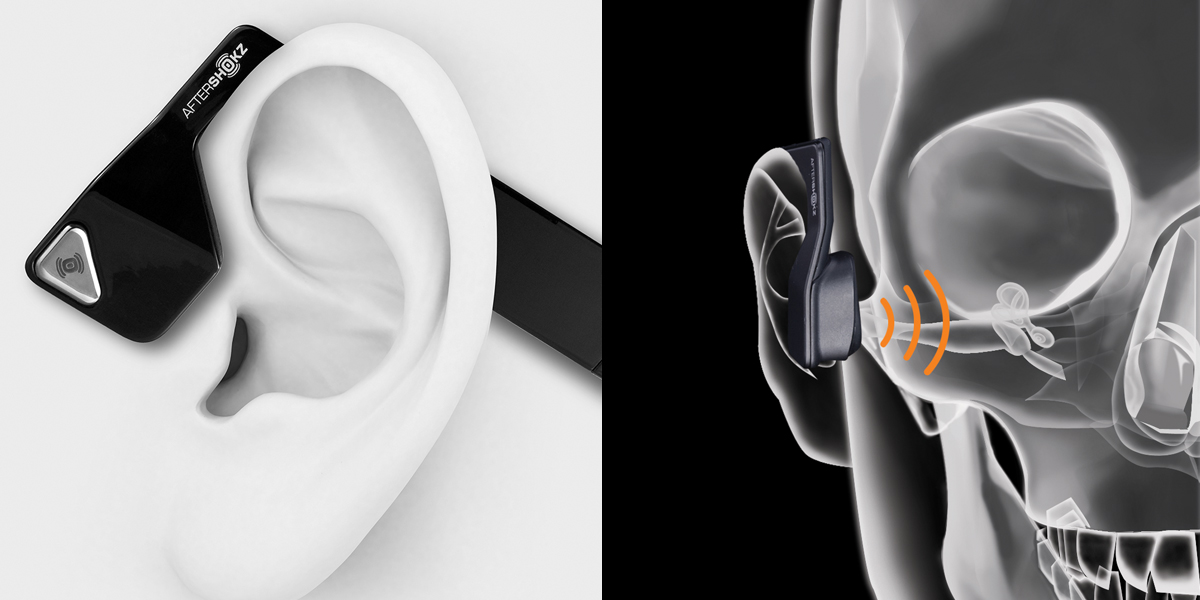
If you're not familiar, this style of device delivers audio as sound vibrations to your inner ear through the bone, bypassing the eardrum entirely. I'd never regularly worn headphones while riding, mostly so I could remain aware of traffic and the world around me. (It's also illegal to wear them while riding in New York City, at least in both ears.) I found the Bluez 2S struck the perfect balance between weight and audio output, while keeping situational awareness levels high. The experience is quite different from your traditional headphones, though, so they won't be for everyone.

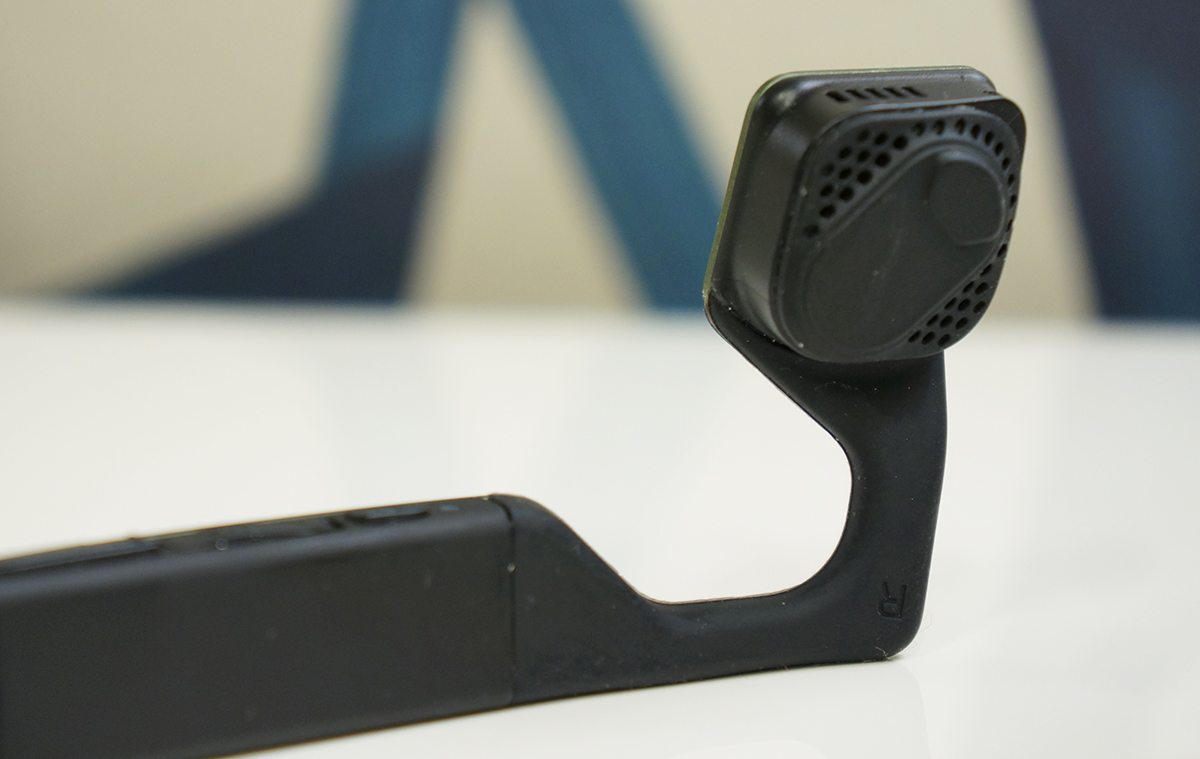
The AfterShokz Bluez 2S is a recent update to the Bluez 2 model, adding the new "PremiumPitch+" technology, which aims to boost the bottom end and prevent sound leakage, alongside slight changes to the external design. There are now perforated openings where the speakers rest on your cheek -- before it was a solid surface. Even with this seemingly more exposed design, the Bluez 2S still meets IP55 standards for dust and sweat protection, which I successfully confirmed over an exceedingly hot and humid summer in NYC. The open speaker surface and revamped internals do indeed make a difference in audio quality and volume. It may not be profound, but it's a noticeable improvement over its predecessor.


The arrival of the 2S dovetails with the announcement of the company's sporty Trekz Titanium, which hit Indiegogo last month and quickly shot past its fundraising goal. Although we haven't tested those yet, it's easy to see the benefit from the Trekz' flexible design. With the rigid U-shaped plastic band of the Bluez 2S that goes around the back of your head, you can imagine the potential for breaking while bouncing around in a bag. That said, I've had them packed in both full bags and jostling around in sparse ones, and nothing has happened to them in several months of use. Also, the headband does get in the way of sunglasses to a certain degree. Since the speakers work best when resting snugly against the cheek, I've had the arms of the glasses positioned above the band (outside just feels weird), which tends to tilt the glasses down and crowd my face a bit. It's not a dealbreaker, but it's certainly not a great pairing.

So how do they sound? First, you need to understand that this is an entirely different experience than regular headphones, with its own set of trade-offs. Music will sound a bit different with this type of technology. The overall sound may be a bit duller compared to your standard cans, but you'll also get a pleasantly spacious head-feel when listening, which is hard to convey. Speech comes across clearly, but the low-end will be lacking in comparison. I frequently have the volume near maximum when I'm hustling on bustling city streets and feeling the music. In quieter environments, however, there's more headroom in volume flexibility. The claim is that PremiumPitch+ helps increase bass, while dampening vibration and reducing sound leakage. The Bluez 2S may not be the loudest pair I've listened too -- Damson's Headbones still hold that title -- but they provide plenty of kick without going overboard on the vibration.


It helps to be a glutton for aural stimulation with bone-conduction headphones. Unlike the isolating experience you get with in- or on-ear models, you get both music and ambient sound leaking in -- which is part of the benefit for me. As long as you're not rocking full volume, you can easily have conversations and hear cars approaching from behind, making it a flexible and safer option if music is a must while riding a bike. For the same reason, they're great when you're walking around the neighborhood, but the sound of a New York subway will certainly overpower your tunes.

On the hardware side, you get Bluetooth connectivity, a volume control rocker that doubles as a battery check and EQ changer, power and a multipurpose button on the left earpiece. Since I'm right-handed, the left-side button is perfect for me. It can pause/play music, skip tracks, redial the last phone number and take calls with its onboard mic. The battery life is rated at six hours of continuous play and 10 days of standby. Indeed, it's great to find the headset charged after neglecting it for a week. It takes about two hours to charge up, but I've rarely drained the headset fully, so it seems to top off rather quickly for me. Bluetooth range is the standard 33 feet, letting you pair with a computer and wander around the kitchen or nearby room without stuttering. It stays paired with your last device though, so be sure to check it's not still tied to the computer if you leave the house and don't hear your tunes. Also, once paired, if the current track isn't playing still, try skipping forward or back one.


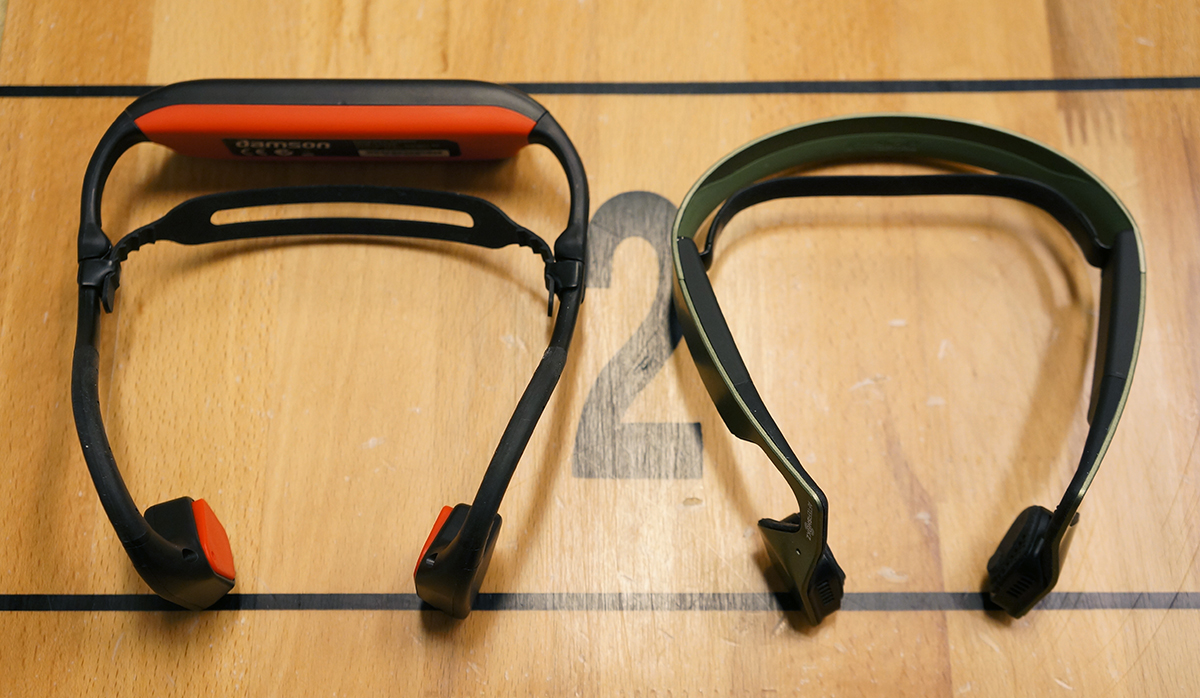
As a comparison, I tested the Damson Headbones, a Kickstarted bone-conduction model from the UK. First, both models get points for awkward naming conventions. The Headbones do have a lot more features including a line-out for earbuds or as a passthrough for non-Bluetooth speakers. They have a bit more playtime at eight hours, APT-X and NFC support, and fold down into a rigid carrying case. As I mentioned, the audio volume is also significantly louder than the Bluez 2S.

This comes at a price, though: The Headbones are more than twice the weight, with a bulky portion that sits at the back of your neck to house the extra flourishes and battery power. Since I ride with a backpack, the hefty rear section bumped up against it making them difficult to wear. While it pumps out a beefier sound, I found the ear (actually cheek) pieces to be a bit too snug and at higher volumes the vibration was uncomfortable. They're definitely a quality set of bone-conduction headphones, but didn't mesh well with my needs and preferences.

The bottom line here is that while you're not going to have the same audio experience as a standard set of headphones, the benefits of the Bluez 2S outweigh the negatives, at least for me in how I use them. I get a comfortable, lightweight wireless headset that provides tunes at a respectable volume, while still being able to maintain awareness about what's going on around me -- an ideal scenario for bike riding. The AfterShokz Bluez 2S is available for pre-order now for $100, while the Trekz Titanium version should arrive in January 2016 for $130.

Bone conduction technology has been around for many years in the walkie talkie accesory market, it has made a several appearances over the years in the leisure headset/earpiece industry, it is perfect for using whilst driving or cycling, like this article shows,  not having to talk into a mic is a massive plus for using this technology.